Showing posts with label Weekly Crude Oil Market Summaries. Show all posts

Saturday, 20 April 2013

Weekly Crude and WTI Oil Market Summary: Brent falls below $100 for first time in 9 months.


15/Apr/13 - 19/Apr/13

In the week preceding this, announcements form major international energy organisations adjusting oil demand forecasts downward caused a massive sell-off of the energy commodity, and the trend continued this week as economic data continued to cause prices falls in WTI and Brent. Brent lost -3.3% and WTI -3.6%, with Brent maintaining its premium as the spread closed yesterday at $11.6, the same level it opened at on Monday. Notably Brent closed below $100 on Tuesday for the first time since July, but failed to maintain a rebound above $100 on Friday.


Weekly Summary

Weak economic data showing Chinese GDP growth failed to meet expectations caused plunging Brent and WTI prices on Monday, with the grade failing to rally in European afternoon trading as US data confirmed economic weakness there as well. Due to the Chinese data, Brent opened in European trading $0.4 below its previous close, and then continued to lose -1.9% in trading. WTI meanwhile gapped down a similar amount but fell a larger -2.5% in trading. Further demand forecasts were cut by the World Bank, which reduced its growth forecasts for East Asia and warned of potential overheating, which would require central banks to raise interest rates. While the sell-off caused Brent to fall to its lowest close since August 2012, markets were more focussed on Gold which lost a massive 10% in one day of trading. The fall was caused by a bearish reaction to signs that indebted governments, such as Cyprus, may have forced to sell hard gold assets in exchange for financial bail-outs.

Crude continued to fall overnight in Asian trading, and Brent lost $1.7 from its Monday close to open in Europe at $99, similar to WTI which lost $1.3 overnight. While the grades rebounded in European trading, with Brent gaining 1% and WTI 1.5%, the earlier falls meant that Brent fell below $100 for the first time in 9 months. The European within-day rebound was similarly seen in other commodity markets, which may have been caused by a fall in the USD and a feeling that the previous drop was too much too soon, prompting some buyers to take advantage of the lower prices.

Such a move was ill-conceived however, and crude plummeted again on Wednesday in a reaction to the weekly EIA release showing increasing production and falling demand. For more details on the release, see my weekly inventory post. Bearish sentiment also entered the market as US corporate earnings came in at disappointing levels, and the USD strengthened from its previous fall, gaining 1.3% versus the euro. The bearish report and negative correlations with such currency gains caused Brent to fall -2.3% and WTI -2.4% on the day.

WTI and Brent had both closed below their lower Bollinger band on Wednesday, which as the graph shows in previous sessions had caused a next-day rebound which was demonstrated again on Thursday, prompted by further technical support from the RSI being below the 30-mark (see my previous technical trading post for more on the RSI). Such signs typically see buyers enter, even if for short-term profits. Signs of longer-term profits were also seen as the long bearish run raised the expectation that OPEC may begin to feel an output cut is necessary. Venezuela is particular announced concerns on Thursday, and with the country under political turmoil following a disputed election, there is a strong incentive for the government to secure higher oil prices and thus budget revenues. Despite the next OPEC meeting not being scheduled until 31st May, prices could rise in the interim as Shell declared force majeure on its Nigerian Light Bonny crude for pipeline repairs and data shows seaborne exports from OPEC will fall in the four weeks to May 4. Rises in Brent and WTI could have been higher were it not for economic activity indicators out of the US coming in negative.


Reports that an ad-hoc OPEC meeting could be held boosted Brent on Friday, but apart from that a lack of notable data traders had a comparatively quiet day, with WTI falling a -0.4% and Brent up 0.2%. By the afternoon, OPEC had denied the announcement and Capital Economics pointed out most OPEC nations are comparatively healthy after recent high oil prices, and so urgency may not be on the cards. PVM, an oil-broker, suggested that the week-end rally is likely to have been caused by a closing of short positions before the weekend and for profit-taking at the $100 mark, resulting in the North Sea blend dropping back to close at $99.65.

Week Ahead

Next week will be quite data-heavy, with a number of global data releases being released. In the US,  everyday next week promises a release that normally moves markets, with home data on Monday and Tuesday, goods orders on Wednesday, the regular weekly jobs update on Thursday and a first-release of Q1 GDP data on Friday. China will see its monthly PMI first release early on Tuesday, which will be of particular note as the indicator has a high correlation with GDP, therefore giving an indication of how Q2 GDP could develop. The euro area first-estimate PMI will also be released after China’s, which could bring the euro zone back into focus again, particularly with investors waiting to see whether the ECB will engage in full-blown QE. This will be followed by the German IFO on Wednesday, which gives an indication of business confidence the euro area’s largest economy. On Thursday UK GDP data will be releases.

On a technical view, investors will be waiting to see whether the current situation is a temporary retracement on a continuing bearish run, or whether we have now hit the bottom and be aligned with fundamentals. Some analysts say $85 would be an appropriate price for WTI, while OPEC in particular may not be happy with less than $100 for Brent. Given current fundamental infrastructure issues between the two grades ( see “On a path to convergence”) mean a spread of closer to $10 than $15 is appropriate, we’ll have to wait and see to find out which grades gives in. For more detailed technical analysis, look out for tomorrow’s week-beginning technical update.

Saturday, 6 April 2013

Weekly Crude and WTI Oil Market Summary: An overdue price correction


01/Apr/13 - 05/Apr/13

Oil experienced its biggest weekly drop in six months this week as WTI lost -4.6% and Brent -5.4% from their previous weekly close. The cause of the drop was a mixture of weak US and Chinese economic data combined with a correction of prices in response to the looser supply situation, as US stocks reached a 22-year high. WTI continued to get support from the start of the summer refinery season in the US while the increase in Brent deliveries in April led to some price pressure for the European blend. Based On this, the premium of Brent to WTI dropped to close the week at a low of $11.4, not seen since June last year.

Weekly Summary

Weaker manufacturing data out of the US and China did little to support economic confidence in markets on Monday, and the early news from the East caused WTI and Brent to both gap down on their opening in Europe, where volumes remained low due to the Easter holiday. WTI lost $1.1 from its Thursday close to open at $92.4, and Brent $0.9 to open at $108.9. Despite the downbeat economic news, the resulting weakness of the USD actually provided support to oil during the day and Brent gained 0.8%. WTI however was hit by news that the Pegasus pipeline in the US, which forms part of a longer pipeline carrying heavy Canadian crude to the gulf coast, was shut due to a leak and big environmental concerns. The news meant more crude was likely to build up in the Midwest and thus put downward pressure on prices, causing WTI to fall by 0.8%.

US February factory orders came out as positive on Tuesday, but the main cause of the increase came from the volatile aeroplane orders component and consumer-durables, which masked a drop in the core orders that signal business investment. Despite the future outlook for investment looking fragile, the increase in consumer goods supported the WTI spot market which gained 0.3%.  Brent however lost ground, falling -0.4% on the day.

The after-hours US API crude inventories report came in extremely negative for markets, showing a 4.7mb rise. The EIA report on Wednesday confirmed a large rise, with the details explained in the weekly inventory analysis. With a number of technical indicators suggesting WTI in particular was overbought on Tuesday’s close, the rise in inventories to a 22-year high coupled with weak economic data to create an extremely bearish environment for both WTI and Brent. The US grade dropped -2.4% while Brent fell -2.9%. Many claimed the correction was long overdue, with the supply situation extremely loose at the moment. The higher fall in Brent resulted in a drop in the Brent-WTI premium, ending the day at just $12.6.

The downward momentum continued on Thursday, with WTI falling by -1.2% and Brent -0.7%, with the technical momentum combining with a weaker US jobless claims number to bring down expectations of growth and spending in the US economy.  

The weaker US job insurance claims number indeed translated into a weaker than expected US non-farms payroll on Friday. Given the indicators position as the most-watched indicator of the month, the negative effect fed into markets where WTI lost -0.9% but Brent lost -2.3%. Weak euro zone retail sales continued to remind traders about the delicateness of the European economic situation and thus Brent demand, while progress from Iranian negotiations about the nuclear situation in that country may have reduced Brent’s risk premium. Meanwhile WTI continues to gain support from the start on the US refinery system despite concerns of the Pegasus pipeline, and the Brent-WTI premium dropped to a low of $11.4, not seen since June 2012.

Week Ahead

Oil may have fallen further this week on supply and demand fundamentals were it not for the fact that the employment situation in the US means the Fed’s QE program will continue for longer, given their targeting of the unemployment rate. This fact resulted in a weaker dollar, which led to some support for USD priced commodities such as oil. Having said this, markets seem to have realised that oil was simply priced too high given the supply situation; a great graph which demonstrates this is the US day’s ahead supply chart as shown below. Clearly, this year’s supply levels, which on this chart takes into account the level of demand as well, is much more elevated than previous years.


Such facts could mean oil may fall weaker this week, but interestingly it’s Brent’s technical indicators that show an indication that the grade may be heavily oversold rather than WTI, which had rallied strongly in the preceding weeks. As the graphs below show, Brent has finished below it's bollinger band on Friday, and the RSI has dropped below 30. Meanwhile, WTI still seems relatively strong on those indicators because of its strong rally the previous week. Indeed, now might be a good idea to buy Brent, given Saudi’s position as a swing producer for global Brent means the nation won’t let supplies increase too high, and given Libya’s continued production problems and Iraq’s indication last week that supplies probably won't be as high as some forecast. WTI meanwhile is benefitting from pipelines being built that themselves hold a large amount of oil and will transfer supply gluts in the Midwest to the Gulf Coast, but if there simply isn't demand in the midwest then prices will once again rise. Most of all it’s important to remember that a lot of US crude is now being shipped by rail, a transport method that costs a lot more than pipeline or ships and thus we would expect a much higher average Brent premium over the year as pipelines are being built – so be careful of expecting the premium to fall much below the $10 range.


Saturday, 30 March 2013

Weekly Crude and WTI Oil Market Summary: Brent-WTI premium reaches cyclical low


Both grades rallied strongly this week, with WTI gaining 3.7% and Brent 2.1%, as fears over a euro zone exit for Cyprus were overcome and economic data from the US was positive. Oil’s positions as an investment asset benefitted strongly from the S&P 500 reaching a record level, and a midweek EIA report showed positive signs for crude demand. This increased demand and signs inventories were shifting to the Gulf Coast resulted in the Brent-WTI premium ending the week at its lowest level since July.

Weekly Summary

Monday saw both grades rise on the day, with Brent increasing 0.4% from its $107.8 open and WTI 1% from its open of $93.9. The main cause of the gains was Cyprus meeting its deadline to secure an international bailout, with the policy shifting from a blanket tax on all depositors to one that will affect only those with a high level of deposits. Gains from the news were pared however when the Dutch Finance Minister Dijsselbloem suggested that so-called “bail-ins”, where the investors take losses rather than an external source, ie. the government, providing support, will be the new normal. This announcement spooked some investors who in turn moved funds from euro into USD, prompting a rise in the American currency and stalling oil’s gains further. Brent may have also received some support from an announcement by the Iraqi oil minister that despite the country’s progress in oil production, targets for 4.5 mb/d output for this year still may not be met due to absence of bureaucratic and political infrastructure.

The strongest day of the week for oil was seen on Tuesday, with WTI gaining 1.7% and Brent 1.2%. While momentum from the Cyprus deal continued, analysts also suggested physical flows were behind much of the increase for WTI, with refiners buying more crude in order to begin the gasoline production for the summer season. Economic indicators also provided support for the rally, with a gain in the US new home sales and prices as well as an increase in goods orders buoying markets. While the orders showed a decrease in those relating to capital spending, often used as proxy for business investment, this followed last month’s large gain and so most were unfazed by the news. The strength of both indicators shows the financial confidence of the US consumer is increasing.

The EIA report on Wednesday provided further support to the idea that refinery production was increasing, and thus that demand for both US-produced WTI should continue heating up over the coming weeks. Further details can be found in my weekly inventory post. The news was positive and WTI rose 0.5% and Brent 0.3%, but gains were pared as a euro zone consumer confidence report fell and the USD strengthened against its peers.

Weaker economic data on Thursday, with unemployment insurance claims up, might normally have led to falls in crude, but the process of the S&P 500 rising to its highest ever close supported markets throughout the day. Hence the week’s daily gains for WTI crude showed no signs of wavering on the last day of trading before the Good Friday close, with the US blend up 0.5% to close the week at $97.2. Brent meanwhile see-sawed in daily trading, with the reopening of Cyprus banks much reported and traders unlikely to take on any large positions before markets reopen in London on Tuesday. The grade eventually closed 0.1% up to end the week at $110. The strength divergence between the two grades resulted in the Brent-WTI premium closing below $13 for the first time since early July 2012.

Week Ahead

Data-wise, Friday sees the month’s most watched indicator, the US non-farm payrolls released. The weekly unemployment insurance claims data has been strong, and so a strong non-farm payrolls number is forecast by economists, who expect a 193,000 gain. Manufacturing surveys for China and US come out on Monday, and will dictate momentum early in the week. The Chinese index, which is only just in expansionary territory at 50.1, is forecast for a large gain of 1pt. Meanwhile the US index is currently well in the expansion region at 54.2, although is expected to fall slightly on the week. Given current US optimism, any lack of a serious fall should be met well by markets while a buoyant China number would definitely spur markets on for the US open. European markets remain closed until Tuesday.

Later on in the week, various central banks including the euro zone, UK and Japan meet to discuss monetary policy. Policy watchers will be keen to see euro zone comments after the Cyprus crisis, and Japan should continue to give an open outlook to monetary expansion.

While there are plenty of data and events out this week that could buoy markets, oil may take a hit if the S&P reverses from its record close on Thursday. Given the rise in the S&P was characterise by smaller and smaller gains in the run-up, there will likely be a correction as short-term traders take profit. Given the links between equities and oil, crude could therefore face a slight fall.

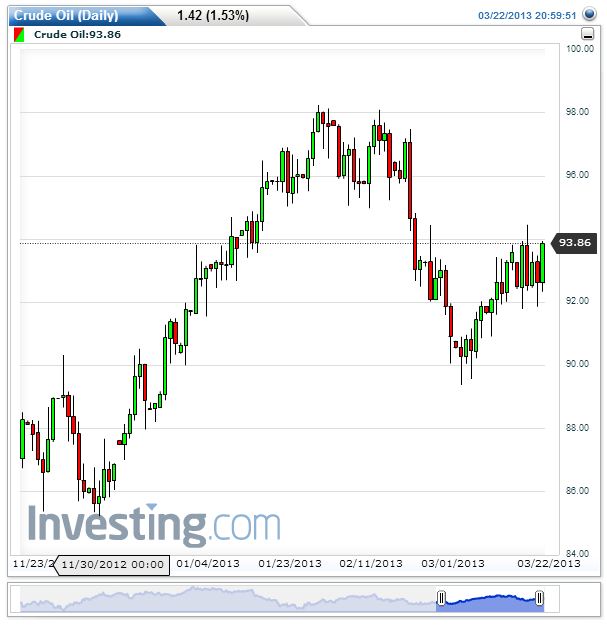
On a trend basis, WTI has rallied strongly this week, and with the start of the US refinery season beginning to start as well as a number of projects being completed to increase the flow of US-produced crude from the Midwest to the Gulf Coast refinery base we could continue to see gains over the coming weeks. The key level to look out for is $98, which the grade has tested twice before this year. This was also the level which the blend crossed in September before rallying up to $100 a few days later (see chart). Hence a strong EIA report or economic data this week could see the WTI blend quickly gaining $2 and even hitting $100 in intra-day trading.


As forecast last week, Brent did indeed rebound from the bottom of its rally and the grade has now gone back up to the $110 area. The grade had trended in $4 range with $110 in its centre before it rose up to $118 earlier in the year on geopolitical issues, and so a return to this range-trading is possible. It’s likely that anything under this range will prompt supply-cuts from Saudi, whereas anything above this is likely to be unsustainable until very strong economic signs from Europe and China.


Saturday, 23 March 2013

Weekly Crude and WTI Oil Market Summary: Brent-WTI premium falls as Cyprus threatens to blow


18/Mar/13 - 22/Mar/13

The previous week has been characterised as a wild-ride in global markets, with equities, currencies and commodities all experiencing sharp volatility. The cause of the volatility was a country in turmoil, as Cyprus had potential to become the first nation to leave the euro zone, potentially setting off a chain reaction with huge ramifications for the whole of Europe. Crude’s position as an investment asset was again demonstrated by its strong correlation to currencies and equities during the week, while the relatively strong domestic situation and improving infrastructure in the US resulted in a narrowing of the Brent-WTI premium. Overall WTI rose 0.2% on the week, while Brent fell -1.9%, resulting a narrowing of the spread by -$2.3 to $14.

Weekly Summary

Both WTI and Brent gapped down significantly from their Friday closing prices, as a proposed depositor tax in Cyprus, stated as necessary to secure an EU bailout, sparked political turmoil and protests in the country. When European markets opened on Monday, WTI was at $92.3, down $1.1 from its close and Brent was down $0.9 at $108.9. During the course of the day however, European leaders communicated that an easing of the bailout conditions was possible, and what seemed to some like a near-certain exit of the first country from the euro zone began to appear less likely. Because of this, WTI and Brent actually both managed to gain on the day, with WTI increasing 1.4% and Brent 0.6%.  Support for the more internationally-linked Brent may have come after comments by Saudi Oil Minister that $100 is a reasonable price for crude, as well as news that a Libyan pipeline that delivers around 120,000 b/d of crude had been shut.

Despite positive signs from the EU, the eventually defeat of the Bill designed to bring the deposit tax into law played havoc in the markets, where WTI fell -1.8% and Brent -1.7%. While some of the losses were due to uncertain expectations regarding future European output, some of the fall was also the result of a sharp decline in the euro and thus a strengthening USD which makes oil less attractive to holders on non-USD currencies. Media attention relating to last weeks’ reversal of the Longhorn pipeline may also have helped push down the Brent-WTI premium, which reached $15.3 by the end of trading.

Volatility continued on Wednesday as Brent prices climbed 1.0% and WTI prices 1.1%, with the main rise being due to the Fed announcing that it will maintain its rate of monetary easing in its monthly meeting, reiterating that the program will be continued until the labour market, which typically lags economic growth, shows signs of improving. In Cyprus, the announcement that banks would remain closed for the week and policy makers would have more time to discuss the EU bailout supported markets. Meanwhile in the US positive signs for WTI fundamentals were demonstrated by the weekly EIA inventory report that showed stocks at Cushing fell again, as explained in my weekly inventory analysis post. As such the Brent-WTI premium continued to fall, albeit only slightly.

Amid a Monday deadline for Cyprus to raise the funds necessary to secure the EU bailout, the country failed to make any progress in securing Russian-loans and instead sought capital controls to prevent funds leaving the island. What’s more, euro zone worries continued on as the manufacturing PMI, a survey-based indicator that closely leads economic growth, indicated a surprise fall in economic output and confidence. Worryingly the surveys that form the indicator were taken before the problems in Cyprus erupted. Hence crude continues its wild ride on Thursday, as prices for both grades deteriorated by 0.9%. Loses could have been worse were it not for supportive data from the US, where business confidence increases, and China where the PMI rose. However an announcement by the Iranian Supreme Leader that they would attack Israeli cities if provoked failed to raise Brent prices through a risk premium.

The euro strengthened against the dollar on Friday as Cyprus lawmakers sought to debate the legislation that would enable the EU to supply the necessary bailout funds, but the announcement that two Libyan oil fields were shut failed to create a rally in Brent which carried on riding the wave of uncertainty rather than responding to fundamentals. At the close of the week, WTI was at $93.7 and Brent at $107.7, with the Brent-WTI premium narrowing by -$2.3 to $14. Some of the price differential likely came from improved transportation in the US, with fundamentals gradually changing in the background of headline news.

Week Ahead

Monday provides the deadline for Cyprus to raise the necessary funds to secure the EU bailout, and failure to do so will result in withdrawal of emergency liquidity support from the ECB for Cyrprus’ beleaguered banks. Under such a situation, the country’s two largest banks will go under and likely take the country with, if no other help is found. Currently there seems hope that Cyprus’ lawmakers will agree on a depositor tax specifically aimed at raising those with the most funds deposited, while Russia continues to have a huge interest in the situation.

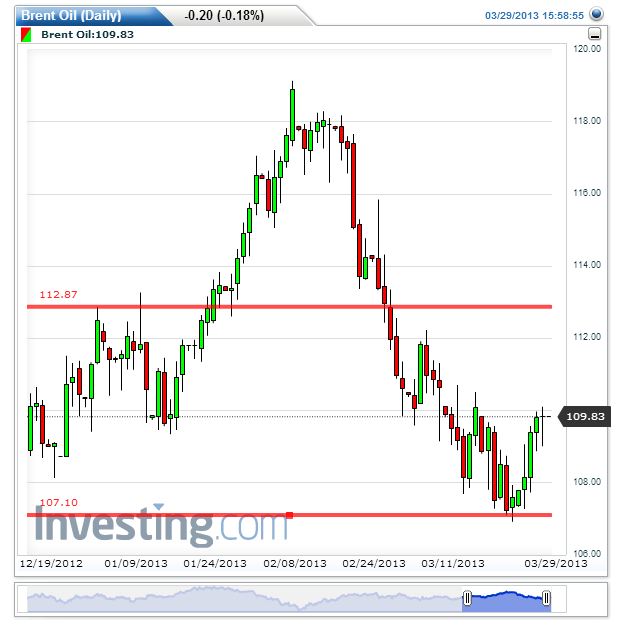
As the graph bellows shows, Brent has been trending downwards for weeks now, and while analysts will at some point expect a bottom for Brent prices, the result of the Cyprus vote will likely dictate whether that will be this week or now. If the vote fails, large falls on Monday are likely, whereas if the vote succeeds Brent will likely bounce back up and may begin following WTI in a similar band-trading pattern as has been experienced by the US blend. Importantly we can note that Brent is now approaching its price level last seen before positive economic signs and geopolitical tensions really heated up. Hence based on this, a higher price is likely if Europe doesn't explode.


Sunday, 17 March 2013

Weekly Crude and WTI Oil Market Summary: Brent-WTI premium drops further


11/Mar/13 - 15/Mar/13

As forecast in last week’s summary, the diverging trends between Brent and WTI continued to be seen this week and the Brent-WTI premium dropped as expected. The premium, which had been $18.9 at last weeks’ close, fell by $2.6 to reach $16.3 by the end of European trading on Friday. While two late days of gains pared an initial three consecutive days of losses, the European grade nevertheless fell -1% on the week, while WTI increased 1.6%.

Weekly Summary


WTI opened in Europe on Monday at $91.8, slightly down in Asia trading from the Friday close of $92. Brent meanwhile had dropped $1 overnight in Asia and continued to be hit by negative sentiment, losing a further -0.2%. The cause of this negative sentiment was Chinese economic data, with the combination of higher-than-expected inflation and lower than expected industrial output growth implying a situation which meant not only was China slowing, but that any attempt at stimulus could result in inflationary problems. The USD meanwhile fell against the euro, possibly only due to a retracement from Friday’s gains in the wake of the positive labour news, but this had the effect of increasing investment flows into the US grade, which by the end of European trading had risen 0.4%.

Two major reports were released on Tuesday; the EIA and OPEC monthly releases. While the former cut its world oil demand forecasts, the latter also cut its growth forecasts for the US and euro zone; the resulting negative sentiment led to a further Brent price cut of -0.4%. Positive news came from China where implied oil demand rose in February, but this was offset by reports that South Korea will be closing a tax loophole in April which will result in less demand for Brent. WTI meanwhile carried on its upward trend, gaining a further 0.4%. Analysts suggest some of this gain would have been further speculation on the Brent-WTI narrowing over the coming weeks, with the Longhorn pipeline reversal  given East Texan crude a route to refiners that will avoid Cushing (see Seaway no Solution). After European trading, the API report showed inventories had decreased by 1.4 mb, against an expectation for the EIA report of a 2.3m rise, which had further positive effect on the WTI blend in US trading.

Despite the drop in inventories shown by the API report, the government-backed EIA survey showed stocks actually increased more than the surveyed 2.3m rise, coming in at a gain of 2.6mb. While overall stocks increased, supplies at Cushing dropped which improved the belief that logistical bottlenecks, the main cause of low WTI prices, are being overcome. This fine detail pared losses for WTI, but the grade nevertheless fell -0.2% due to the inventory increase. On top of this news, the IEA released its monthly report which confirmed a 2013 oil demand decrease as also forecast by the EIA. The international agency also reported that OPEC production had increased in February, with output in Iraq in particular growing strongly. Adding to supply issues was further negative sentiment in the euro area where industrial production fell 0.4% m/m. The combination of a weaker European demand picture and increasing OPEC supplies led to further speculation that the Brent-WTI premium will fall. Indeed the grades closed at their lowest difference since January at $15.7, caused by a larger fall in Brent of -0.9%.

Brent finally saw some respite on Thursday, with both grades gaining strongly after US jobs numbers came in positive for the third consecutive week and the oil risk premium increased after US President Obama confirmed military force remained an option to prevent Iran gaining nuclear capability. Additionally in the US, a bipartisan group introduced a bill into the Senate that would give Congress the power to approve the Keystone XL pipeline without Presidential approval. While the technicalities and legality of the bill could be called into question, the pressure from the action should nevertheless prompt Obama to make a decision sooner rather than later, with the majority believing the pipeline will be approved. Such a decision could further alleviate supply gluts. Oil also received a boost from a further easing of the USD, and by the end of European trading WTI was up 0.8% and Brent 0.9%.

Brent continued to outpace WTI on Friday, with the European blend gaining 0.5% veruss at 0.2% rise in WTI. The positive momentum came despite a slip in US consumer confidence. Rather, a CPI release showing inflation is contained reduced the chance of the Fed pulling back its monetary easing program, thus leading to a further depreciation of the USD and therefore flows into oil as it became a more attractive investment, particular with both short and long term forecasts for US oil prices to increase. By the end of European trading, WTI had reached $93.5, a rise of $1.5 from its previous close, and Brent $109.8, down $1.1. The last two days of Brent strength resulted in the Brent-WTI premium widening, but the premium nevertheless fell to its lowest weekly close since January 18th.

Week Ahead

Data-wise, the German ZEW on Tuesday could dictate European economic sentiment, while US housing starts could prove positive for markets given the current consensus of a larger rise than last month.  The annual UK budget will be announced on Wednesday with its possible market implications, and later in the afternoon the Fed will meet for its rate decision, with market participants continuing to look for any clues regarding how long quantitative easing will continue. A fourth consecutive week of increasing jobless claims could combine with positive existing home sales data and an improving business conditions index on Thursday.

Charts-wise (see below): On the daily chart Brent formed a reversal pattern on Thursday and Friday, with the so-called tweezers bottoms on Wednesday and Thursday leading to a “three inside up” when including the week-end. If Brent strength continues on Monday, a “three white soldiers” pattern will have formed, implying an upward trend is beginning. WTI meanwhile continues to trend upward, and strength indicators such as the RSI indicate this trend could continue, showing positive momentum but not signalling the grade is anywhere near overbought. WHat's more, the crossover of the 10 & 20 day MA could occur on Monday, which has previously served as a good buy signal. Hence, technical indicators suggest WTI should continue upward at least until its prior support/resistance area of $94.6.


While a positive Monday for Brent could suggest this week’s losses were the end of a downward trend, it’s hard to see Brent gaining much strength in the face of increasing output and with economic growth signs remaining tentative in Europe and Asia. Having said this, a positive ZEW on Tuesday could provide some short-term support. While such an outcome could prevent any serious change in the Brent-WTI spread for the next couple of weeks until confirmation of pipeline effects come into being, if WTI manages to breach its $94.6 resistance level then it could continue to hurtle upwards until the $97-$98 range. Hence I expect to see either a generally stable or slightly decreasing Brent-WTI premium this week.

Sunday, 10 March 2013

Weekly Crude and WTI Oil Market Summary: Brent-WTI premium falls on US data


4th – 8th March

Early concerns of US fiscal cuts and Chinese economic growth were overcome this week, with record US equities on Tuesday, a weaker USD midweek and positive US jobs numbers on Friday all supporting prices. Overall WTI gained 1.4% and Brent 0.5%, resulting in the Brent-WTI premium falling by $0.8 to reach $ 18.9, the lowest point since January.

Weekly Summary

WTI crude opened the week at $90.6 and Brent at $110.4. Prices fell on Monday as momentum from Friday’s trigger of automatic spending cuts in the US continued, with Brent falling -0.3% and WTI -0.6% in European trading. While news of a shutdown of a key Brent pipeline early in the day did prop up Brent prices temporarily, it was not enough to overcome fiscal concerns as well as negative factory output data from China.

Markets rebounded on Tuesday, propelled by positive sentiment from both the US and China. In the former the Dow Jones Industrial Average rose to the highest level since 2007, while in China leaders committed to targeting 7.5% economic growth and reaffirmed that it will be concentrating on domestic consumption. Such a statement limits perceived downside risks to oil markets from a potential Chinese slowdown, with the belief that further stimulus will be undertaken if economic concerns come in to play. By the end of European trading, WTI had risen 0.6% while Brent gained 1.4%. Toward the end of US trading the API inventory report showed a steep increase of 5.6 mb, including a large increase at Cushing. However the fact that product inventories fell by more than forecast provided some support.

News on Tuesday evening that Venezuelan president Huge Chavez had died caused Brent to gap open somewhat on Wednesday, gaining $0.2 from its previous close. However any chance of a continuation of Tuesday’s momentum was cut short by the EIA inventory release, confirming a large increase in crude stockpiles of 3.8 mb, above a survey estimate of 0.8 mb. This took US inventories to the highest level seen since June, while refineries continued to maintain low utilisation rates. Although this is not unusual for this time of year, the drop was more than anticipated. A further hit to Brent came after news that pipeline flows had resumed after the incident earlier in the week. In all, Brent fell -0.6% while WTI dropped -0.4%.

A combination of a successful Spanish debt auction and the decision by the European Central Bank not to raise rates led to a strengthening euro vs. the USD on Tuesday. The US blend benefited from the currency movements, gaining 1.2%, as anticipation of higher product demand and higher investment flows surfaced. Brent however changed little, rising just 0.1%, as a combination of resumed pipeline flows and a lower dollar played off each other. A technical support of $110 remained unbreached as investors waited key US and Chinese data on Friday.

The first of such data, Chinese crude import demand, came in at a disappointing 9% y/y drop for February, although some of this would have been caused by the occurrence of Chinese New Year in February 2013 vs January 2012. Such news caused an initial drop in Brent prices, with the grade dropping below $110 in early trading. US jobs number later in the day came in strongly positive, with the unemployment rate falling to 7.7% after the US economy added 236,000 jobs versus a consensus forecast of 160,000. Such news provided positive sentiment regarding expectations of US growth, resulting in a rise in the US grade of 0.7% by the close of trading. The flip-side to the news however was that the USD rallied after its Thursday decline, gaining 0.7% versus a basket of currencies and thus preventing any daily gain to be seen in Brent. By end of European trading, Brent was up $0.8 on the week, closing at $110.9, while WTI gained $1.3 to close at $93. The corresponding Brent-WTI premium fell by $0.8 (differences from rounding) to end at $18.9.

Week Ahead

The Brent-WTI premium could be the one to watch this week, with the difference in the two grades falling to below $19 for the first time since 31st January. Indeed, a quick scan over the Brent and WTI charts shows a clear divergence in trends of the two grades as summed up above. If these different trends continue the premium would drop further.

Such a fall would thus be the result of diverging economic differentials rather than supply fundamentals (a summary of which can be found in my previous post Seaway No Solution), with the US grade gaining over Brent on positive US data while both grades tend to rise on positive data from Europe. Such a situation is clearly delicate; US supply continues to gain ground although has abated in the last two weeks with US crude production flat. Meanwhile Middle Eastern issues have been largely out the news this week as media focused on US fiscal concerns and jobs data. Any new events relating to Middle Eastern concerns could easily ramp up the Brent risk premium and thus price, while WTI could lose ground as easily as it gained (relative to Brent) if production is seen to increase or refiners don’t eventually come out of their low utilisation cycles. Having said this, Goldman Sachs this week reported the belief that refinery and product demand was in fact artificially low as key infrastructure repairs following Hurricane Sandy are still not complete.

Data-wise, credit-growth in China will be reported before markets open on Monday which if positive could lead to initial gains as positive economic momentum from Friday continues. Japan could also officially approve its central bank governor on Monday, although any effect is likely to be minimal as the market has already priced in much of the aggressive monetary easing that is expected under the new leadership. German consumer confidence on Tuesday will likely lead momentum in Europe, with a positive number indicating a supportive Germany crude demand in conjunction and potentially strengthening the euro. Meanwhile Friday’s US consumer price index release, if higher than last month’s, could further fuel speculation that the Fed will soon have to reduce the intensity of its asset purchasing program.

Sunday, 3 March 2013

Weekly Crude and WTI Oil Market Summary: Italian and US uncertainty weighs on markets


25th February – 1st March

Political instability in Italy reignited the European economic crisis this week, and both Brent and WTI experienced large losses, with Brent falling -3.2% and WTI dropping -2.6%.While losses for WTI were mostly seen on the last two days of the week, Brent suffered each day after a modest increase on Monday. With Brent falling further than WTI, the Brent-WTI premium dropped to $19.7 at the end of the week, $1.3 less than the previous Friday.

Weekly Summary

WTI opened at $93.3 on Monday, while Brent opened at $114.1. While the Italian election was the main media point of the weekend, full results were not yet in by the close of European trading on Monday and so markets made no large movements in either direction.

By the open of European markets on Tuesday, news reports showed a picture of a power vacuum in Italy, with prominent anti-austerity parties gaining ground. Such news had been apparent overnight, resulting in markets in the US and Japan dropping, and both WTI and Brent opened $0.8 down on Tuesday. Throughout the day there were reports that Western powers were offering a greater compromise to Iran regarding international sanctions, which may have eased the Brent risk premium somewhat. WTI finished the day somewhat higher as US consumer confidence came in stronger than expected. Overall the Italian news and its implications affected the European grade more than the American benchmark, with the former dropping -0.8% and the latter increasing 0.3%, resulting in a drop in the Brent-WTI premium saw a drop of $1.2. Such instability also has the effect of appreciating the USD as a result of safe haven flows, thereby causing further pressure on oil as it becomes more expensive for non-USD currency holders.

Brent continued to drop amid European economic worries and political instability in Italy on Wednesday, falling in European trading by a further -0.8%. Meanwhile WTI was stable after an EIA report that showed mixed signs for the US grade (see my weekly inventory analysis post). A declining risk premium was confirmed as Iran hailed negotiations as a positive turning point with Western powers, but losses were pared after Fed chief Bernanke defended the US QE program before congress, while in Europe ECB chairman Draghi confirmed liquidity would be provided as long as it was required. Such high-profile statements signal central bank’s intent to continue doing whatever it takes to ensure a stable economic environment.

US sequester negotiations took the spotlight on Thursday, with democrats supporting a mixture of tax rises and cuts while Republicans looked for a program of pure cuts. Failure to reach an agreement meant an automatic cut in spending totaling $85bn, which could potentially cut 0.6% off economic growth this year. Positive US jobs data were not enough to overcome uncertainty over whether a deal would be made, and WTI dropped -1.1% while Brent fell -0.5%. Technical factors may have enhanced negative momentum for oil, with the benchmark Brent dropping below its 100-day moving average, where sell orders are often clustered.

An early negative data release out of China set the scene for the rest of Friday’s trading, with the PMI manufacturing coming in at the lowest reading since September. With China forecast to be the main driver of oil demand in 2013, both grades fell overnight in Asian trading, leading to WTI and Brent both gapping down $0.5 for the London open. Negative momentum continued in Europe, and the start of US spending cuts combined with news of OPEC export growth in February to push WTI and Brent down, with the US grade falling 1% compared to a 0.5% fall in Brent. Overall WTI finished in European trading at $90.7 and Brent at $110.4. Despite US inventories increasing, the Brent-WTI premium fell $1.3 compared to the week earlier, perhaps due to a fall in risk-premium for the European grade.

Week Ahead

Media reports continue to emphasise political instability in Italy, while there has still been no further progress in agreeing to new spending terms in the US. Such news will likely dominate markets again this week, but the economic release to look out for will be Friday’s US non-farm payrolls employment report. Weekly jobless claims have been positive in the last few weeks, which could mean employment numbers have gained.

Such a result could mean a further narrowing of the Brent-WTI premium in the coming week, with economic worries likely to damage Brent in terms of both demand fundamentals and due to further US safe-haven flows strengthening the USD. WTI meanwhile will gain greatly if US economic signs continue to shine.

Sunday, 24 February 2013

Weekly Crude and WTI Oil Market Summary: Oil markets correct on technicals and fundamentals


18th – 22nd February

Both WTI and Brent experienced large falls this week, with markets taking a greater emphasis from fundamentals while a number of technical factors contributed to the sell-off. Overall Brent dropped 3.1% while WTI decreased by 2.9%. Despite a more focused emphasis on supply fundamentals, market perception of the factors affecting the Brent-WTI spread did not change, and the divergence ended the week at $21, down slightly from $21.8 at the beginning of the week.


Weekly Summary

WTI opened at $95.8 and Brent at $117.8, both $0.1 down from where they closed on Friday. The first day of the week saw low trading volumes, with US traders taking time off for President’s day. The main news on Monday was that Saudi had reduced their exports in December to a 15-month low, confirming the effects of a declining trend in crude production after it was announced earlier in the month that January production reached a 15-month low. Despite this news, or perhaps because it was just a confirmation of a known trend, both grades fell -0.3% in European trading. Having said this, with trading volumes 80% below normal levels, it’s more likely individual investors actions led to the fall in price, which may have been related to non-speculative purposes.

WTI made up for two previous falls with a 1% rise on Tuesday, while Brent maintained its price. The rise in WTI came despite no significant crude-related news events, and instead resulted from a rallying of US equities which have been strongly correlated with WTI over the past months. Such an idea was confirmed by Tim Evans of Citi, who stated “it’s likely a correlated trade flow that isn’t based on oil market analysis”. This emphasises a key point to bear in mind over 2013; true, there should be some correlated between expected growth, represented by equity prices, and oil prices – but has the correlation of the longer term trends rather than just average daily price changes resulted in an oil price that doesn’t truly reflect its fundamentals?

Indeed, on Wednesday we began to see a correction in response to the view that oil prices were becoming disconnected from reality, and WTI saw a -2.1% decline while Brent dropped -1.5%. While many cited the decline as a likely prospect in response to technical developments (Brent technical analysis and WTI technical analysis), the drops nevertheless were set off by a variety of factors including rumours that a fund was forced to liquidate its entire oil position. On top of this, the fact that Wednesday was the expiry day of the March contract meant that those long oil had to sell the front-month contract in order to roll forward to the next month, thus exerting further pressure on the spot price. Economic expectations were also at play, as the FOMC minutes showed that some monetary policy makers were beginning to feel a rolling back the intensity of the QE program was appropriate. The effect of this is not only to reduce the expected future money flows into commodities, but also to cause appreciation expectations of the USD to rise, thus reducing the attractiveness of oil in terms of both the spot market and as an investment. While some suggested the WTI sell-off could be related to US market fundamentals, an interesting point was that the Brent-WTI spread actually saw some narrowing, suggesting that market perceptions of the factors influencing the spread had not changed.

Thursdays trading contained no respite for either WTI or Brent, and former dropped -2.1% while the European grade fell -1.5%. PMI data in the euro area showed a surprise drop, pointing toward an economic contraction for Q1. Adding to European woes were negative US initial jobless claims numbers and a fall in the Phili Fed’s business activity index, which dropped for a second month. While sentiment remains US-bullish, such data emphasise that there continues to be short-term economic volatility. Trading down was also likely due to technical pressures as investors perceived the drop past support areas as signs that there could be some short-term losses as the grades corrected.

Having said this, both grades pared losses on Friday, with a positive release in the much-watched German Ifo survey making investors believe the -3.3% WTI and -4.5% Brent falls in the last two days were probably too high. The German data was the largest increase in German business sentiment in 2-years, which fuels hopes that Europe’s largest economy could continue to pull the remaining countries through this recession. Nevertheless gains were limited by a continuation of a stronger dollar; WTI increased just 0.2% while Brent increased 0.4%. USD strength was enhanced by concerns that Sunday’s Italian election will bring back to power political forces that ensured the country experienced one of the lowest average global growth rates of the last decade - such a result could reignite the euro area debt crisis. Overall WTI finished the week at £93.1, $2.8 from its close last Friday, while Brent finished at $114.1, $3.6 down.

 Week Ahead

The week ahead will likely be highly politised, with markets reacting to the Italian election on Monday and focusing on Iran nuclear negotiations that begin on Tuesday. The main US news will related to the $85 billion sequester, a collection of automatic spending cuts  that come in to effect on 1st March unless they can be avoided by political negotiations. As recent history has shown, any agreement will likely come at the very last minute on Thursday, and so markets will likely be on tender hooks with perhaps a big move on Friday.

Data-wise, look out for Bernanke testifying in front the of Senate Banking Committee on Tuesday as well as US consumer confidence on the same day. US durable goods orders, an indication of investment, will be released on Wednesday while various Q4 GDP figures will have their second update this week. Normally these do not change a great deal. Chinese PMI data will be released early Friday morning before the US equivalent later in the day. The market typically moves in response to these, so we could see some large moves on Friday if US political negotiations go in the same direction.

Saturday, 9 February 2013

Weekly Crude and WTI Oil Market Summary: Brent-WTI premium back to November levels


4th – 8th February


WTI suffered this week as the Brent-WTI premium widened significantly to $23.2. The US blend, which fell -2.1% from its previous weekly close, suffered as traders continued to speculate as to the time frame in which WTI delivery to refiners would finally be free from constraints. Brent meanwhile came under pressure from improving economic fundamentals as well as a Goldman Sachs warning that prices were likely to be higher than forecasts this quarter. The grade finished the week at $118.9, 1.8% higher than its previous weekly close.


Weekly Summary

Monday started negatively for both Brent and WTI, with the former gapping down $0.4 to $116.4 and the latter gaping down $0.2 to $97.6. This negative sentiment gained momentum throughout the day due on economic news, with reports from France’s El Pais newspaper claiming the ruling Spanish party had received unauthorised funds, thus adding more uncertainty in the much beleaguered European country and thus the euro zone. Elsewhere news from Iran’s foreign minister stating that Iran would consider bilateral negotiations over Iran’s nuclear program resulted in a drop in risk premium in prices. While Brent fell -0.7%, WTI was hit hardest in line with declining US equities, although some of this drop could have been in response to overbought technical indicators on the back of last week’s strong gains.

Oil rebounded on Tuesday as economic indicators for service sector activity in both the US and Europe came in as positive. Given Monday’s negative European sentiment, the news was particular welcome and provided strength to the euro which appreciated versus the USD, thereby making oil more attractive to European buyers. Brent continued to outpace WTI as traders awaited the results of the API industry report on crude stocks, with the North Sea grade gaining 0.9% versus 0.6% for WTI. This price differential resulted in the Brent-WTI premium topping $20 for the first time this year, ending the UK trading day at $20.1, but dropping below the $20 mark in the US after the API survey showed stocks at Cushing fell to the lowest point this year.

Trading on the day of the weekly EIA oil report resulted in little change in WTI while Brent increased 0.2%. As the breakdown in my weekly EIA analysis explains, a decline in stocks at Cushing was enough to offset an overall increase in inventories and negative demand signs in breakdown of the EIA report. Brent may have seen some upward pressure from a tightening of sanctions on Iran, while negative effects from a slight USD appreciation would have offset positive effect from a slight rise in USD equities.

The Brent-WTI premium carried on rising on Thursday as media outlets reported that work on one of the crude processing units at BP’s Whiting, Indiana refinery would not be ready until July, 3 months later than expected. The consequences of this 260,000 barrel a day unit not being available means stocks in Cushing will be under even further pressure than previously thought, and the WTI price fell -1%. Adding to the spread differential were two main points of news out of the Middle East; firstly a Gulf official stated output there had fallen to its lowest level since May 2011 at 9.05 mb/d, and secondly the Iranian Supreme Leader stated that the country would be unwilling to take part in the bilateral negotiations with the USA that had seemed possible earlier on in the week. While the former affected oil market fundamentals, the latter also added to the risk premium, and Brent rose 0.3%. The fact that Saudi production has continued to fall to new lows shows signs Saudi is intent on keeping the oil price high, and so many analysts may raise their annual Brent price forecasts.

Trade data showing 25% y/y export growth came out of China early Friday morning, while the breakdown showed crude inputs had risen to the highest level in 8 months. Positive momentum for Brent followed and the grade maintained its velocity throughout the day, increasing 1.2% to close at a 9 month high of $118.9. Added to the upward pressure was a release by Goldman Sachs predicting oil markets would remain tight in Q1 and prices were likely to be above forecasts; such releases from the banking giant usually create a trend, and a notable point of the release was their view that the price had increased purely on fundamentals rather than incorporating a further risk premium. Trading sentiment for the US crude remained negative, and WTI failed to be boosted by the momentum affecting Brent and the grade fell 0.1% to close at $95.7. While some positive was taken by data showing increasing US crude exports last month, the Brent-WTI spread nevertheless rose by a further $1.5, closing the week at $23.2, a level not seen since 22nd November.

Week Ahead

As predicted in last week’s weekly summary, WTI prices did indeed fall this week, although the extent of the Brent-WTI spread widening has been massive due to a resounding week for crude prices. The Brent-WTI spread has now increased every day for 8 days, since the announcement of capacity restrictions on the Brent-WTI spread. I’ll be addressing this issues again in another post later today, to give a more detailed insight on how the spread could develop over the coming months.
Brent prices are particularly elevated at the moment, and for now the most important things to look out for this week will be further news regarding Iran, further data showing economic fundamentals improving and signs regarding inventories at Cushing. If Cushing inventories decrease, we should see WTI rebounding to some extent, but lack of significant positive news would result in Brent retracing after its huge momentum on Friday. Overall we could see a slight decrease in the prices of both grades this week.

Sunday, 3 February 2013

Weekly Crude and WTI Oil Market Summary: WTI-Brent spread widens on Seaway issues

28th January – 1th February

Weekly Summary

Continued signs of macroeconomic recovery in the US on Monday provided a continuation of momentum from last week, and WTI and Brent both saw gains. Brent, which had opened at $113.3, increased 0.2% while WTI rose 0.5% from its opening price of $95.9. Positive data came from signs of increased business orders, a proxy for investment, although gains were pared by signs that pending house sales had fallen. News that integrated oil company Hess was to close its last refinery in the US, located in New Jersey, also boosted gasoline prices which led to rises in WTI. As this article reports, such refiners are unable to access much of the domestically produced oil due to their location away from key pipelines and therefore have still been relying on the more expensive Brent-indexed imports to produce gasoline. Unable to compete on costs, the refinery has closed and there is an expectation that more WTI- produced gasoline will be required to meet the lost supply. There was also a slight rise in the risk premium after further terror attacks against an Algerian pipeline as well as reports out of Iran on Saturday stating the government would give military support to Syria against any Western intervention there.

Positive economic momentum continued on Tuesday, with US house price data showing a tenth month of rising house prices which led to significant gains in US equities and an improving perception of future oil consumption demand. The situation in Europe was also given a boost by the first rise in German consumer confidence in four months. On this positive news Brent increased 0.8% while WTI gained 1.1%, with the WTI-Brent spread narrowing by $0.2 to $16.8.

Despite US GDP coming in at a surprise negative -0.1% and EIA inventories increasing more than expected, both grades gained on the day in the face of improving sentiment in Europe, increased political risk in the Middle East and as the dollar weakened after the monthly Fed meeting.  Markets reacted negatively to news that crude inventories had risen +5.9 mb versus a consensus of +2.5 mb, but oil soon pared losses as the Fed announced a continuation of asset purchases, which led to a weakening of the dollar and thus an increase in the attractiveness of oil for those outside of the US. This was reinforced by a French news report that Israel had attacked a Syrian weapons convoy, thus creating the possibility of retaliation attacks against Western-backed targets.

Thursday saw what was almost a delayed reaction to the Wednesday EIA inventories report, which in conjunction with an announcement from Seaway Pipeline operator Enterprise, led to WTI falling -0.5%. The pipeline is facing trouble because despite increasing the pipeline capacity, the glut has now built to such an extent at the end of the line at Jones Creek that pipeline through-put has had to be curtailed as there is no spare storage capacity. Although this has been affected by a temporary closure of a refinery in the area, it shows just how high supply is that even temporary scheduled maintenance is having a large effect on the ability of companies to shift crude. 

Despite news that a new pipeline and storage facilities will come on during the year, it appeared some traders were closing out of position that were set up to bet on the spread narrowing. Closing out of such a long-WTI, short Brent Position, would put negative pressure on WTI and positive pressure on the Brent price. As such, WTI fell -0.5% and Brent increased 0.6%.

Friday saw positive news from the US from an increase in the US non-farm payrolls number. While WTI increased 0.2%, Brent saw a higher rise 0.9% on further geopolitical issues coming from a suicide attack at the US embassy in the Turkish capital of Ankarra. Reuters also cited further exits of the WTI-Brent spread trades as reason for Brent rising further than the US blend, as traders had time to further consider the implications of pipeline news on Thursday. On this the WTI-Brent spread widened further and closed the week at $19, having increased by $2 in two days, with WTI at $97.8 and Brent at $116.8.

Week Ahead: WTI to fall?

The big news last week was certainly the fact that the Seaway Pipeline will be nowhere near as effective as thought in reducing the glut of WTI supply. We saw the spread at around $19 at the beginning of January, just before the increased capacity came in to place. The spread has already returned to this point, closing at $19 on Friday. However it’s important to note that WTI is at a price of $97.8 now versus about $92 at the beginning of the year. Although there has been an increased risk premium, the more the WTI glut builds up the less the risk premium will be reflected in the WTI price as the majority of the product will just not be moveable, and will instead be subject to increased costs from higher demand for storage. Although the macroeconomic signs are strong, supply fundamentals have to overcome sentiment at some point, and I would expect to see deterioration in the WTI price this week, which would be the first fall in 9 weeks. A point of great interest would be if this fall is combined with a rise in the Brent risk premium dependent on geopolitical issues this week, which would imply a widening of the WTI-Brent spread.

Sunday, 27 January 2013

Weekly Crude and WTI Oil Market Summary: WTI-Brent spread widens on limited Seaway capacity

21th – 25th January

A climb of 0.3% for WTI meant a 7th consecutive weekly gain this week, making it the longest upward trend in the grade since 2009. While both WTI and Brent benefitted from upbeat, albeit tentative, macroeconomic signs in the US and China, WTI suffered mid-week due to problems with the Seaway Pipeline out of Cushing. A 1.3% weekly gain for Brent meant a second weekly rise in the WTI-Brent spread, which now stands at $17.4, up from $16.3 the week before.

Weekly Summary

WTI opened at $95.9 and Brent at $111.8 on what turned out to be a relatively slow news day on Monday. Given it was Martin Luther King Jr day in the US, trading volumes were particularly low. Meanwhile, traders were awaiting outcomes from a meeting of EU finance ministers in Brussels and the result of a Bank of Japan (BoJ) meeting in Tokyo. Overall there was no strong direction in either grade; WTI increased 0.1% while Brent declined -0.1%.

While the announcement came late on Monday night, it was not until Tuesday that markets could react to the announcement from the BoJ that the Bank would be engaging in monetary stimulus policy, committing to purchasing $145 million of assets a month in a similar programme to those seen in the US and the UK. The BoJ hopes that this will stimulate demand and inflation in Japan, which accounts for 5% of the world’s oil demand. While an announcement was expected, it was the open-ended nature of the purchase commitment that particularly buoyed markets.  The positive momentum from this announcement continued in the day as a number of economic surveys also saw positive results, with the German ZEW indicator of economic confidence  climbing to its highest level since May 2010 and a Bloomberg survey showing a majority of investors expected to increase their holdings of securities over the next 6 months. In particular a majority also expect equities, of which oil prices tends to be correlated, to provide the biggest returns. These positive indicators were further enhanced by positive sentiment in markets from expectations that the US House of Representatives would pass a bill temporarily suspending the nation’s borrowing limit. Overall WTI climbed 0.9% while Brent increased 0.6%.

Expectations of a supportive result regarding the US debt ceiling were proved correct on Wednesday, with policy makers suspending the debt limit until the 19th May, providing the US with fiscal breathing room for a further few months and thus providing overall positive sentiment to markets on Wednesday. While the news was positive for Brent, an announcement that capacity on the Seaway Pipeline from Cushing was limited due to unforeseen circumstances severely knocked WTI prices, with the grade dropping -1.6%. While the limited capacity will mean further problems for those delivering WTI to Cushing, it also means some refiners may have to cut planned production and so demand may temporarily fall. With Brent increasing 0.4% on the positive US news, the fall in WTI meant a significant rise in the WTI-Brent spread, with the premium of Brent over the US grade increasing $1.90 to $17.6, the highest level in two weeks.

Thursday was another day that saw a combination of strong positives for oil demand expectations, with WTI rising 0.8% and Brent 0.4%. Positive macroeconomic indicators came from both the US and China, which together account for just over 30% of world oil demand. In the US, the weekly initial jobless claims figure fell to the lowest level since January 2008 while the preliminary Chinese manufacturing PMI, a sign of manufacturing strength, rose to 51.9 in January. Coupled with this macroeconomic news was the later than normal weekly EIA inventory data. While overall crude stocks came in higher than expected, the detailed breakdown showed some positive sign for both grades in terms of product demand while falling US net imports was positive news for US produced crude. For more on this see yesterday’s weekly EIA inventory post.

The German Ifo survey, an indication of German executives’ market confidence, increased for the third month running on Friday, while the European Central Bank announced financial institutions will utilise an early repayment opportunity to a greater extent than expected on loans issued from the ECB. While on any other day this news would have resulted in visible gains in the oil markets, a combination of gains throughout the week and overbought signs from technical indicators resulted in traders taking profits instead, and each grade remained stable on Friday. Overall WTI closed the week at $95.9 while Brent reached $113.3.

Week Ahead

Now the House has voted on suspended the federal debt limit for some months, the intensity of market reaction to domestic US political events may take a step down for a few weeks, with macroeconomic demand signs instead taking the main stage. With this in mind, look out for a number of important economic events out of the US this week, with both the advance Q4 2012 GDP number and latest FOMC meeting on Wednesday. Friday also sees the monthly non-farm payrolls release which is perceived as perhaps the most important macroeconomic indicator, providing an indication of economic strength through labour market developments. The ISM manufacturing index shortly after this will also give an indication of how US producers are faring. For a useful summary of these releases and market expectations see this article at Marketnews.com. In addition to this news, WTI is likely to see gains and the WTI-Brent spread narrow when there is confirmation that the Seaway Pipeline capacity is back up, which is expected this week.

Sunday, 20 January 2013

Weekly Crude and WTI Oil Market Summary: Geopolitical risk rises


14th – 18th January

Both Brent and WTI saw gains this week, with Brent rising 1.9% and WTI 1.8%. Although the percentage rise in WTI was smaller, the grade did jump up $0.3 on Monday opening from its previous close, and this meant the WTI-Brent spread did narrow $0.1 to $16.30. This lack of any significant narrowing of the spread, despite the completion of the Seaway Pipeline reversal, was caused by geopolitical tensions, with al-Qaeda linked to a terrorist attack at a gas production plant in Algeria. With many international oil blends linked to the North Sea grade, this attack had the effect of increasing the risk premium on Brent.

Weekly Summary

WTI saw a cautious increase on Monday, gaining 0.2% as the effects of the reversal of the Seaway Pipeline continued to feed through into less downward price pressure on WTI. Brent saw a large rise of 1.1% as a weaker dollar made the international grade more attractive for non-US buyers, with the dollar fall in part caused by comments from regional Fed governors saying that more monetary stimulus could be provided. Both grades also benefited from forecasts for colder weather throughout both the US and Europe that saw end-products such as gasoline and heating oil rise. Despite this upward pressure on oil prices, gains were pared by negative developments in equity markets as the President Obama made a surprise news conference to address political issues with the US debt ceiling, increasing market worry that the issue will not be solved in time.

Market continued to feel negative pressure regarding the US debt ceiling on Tuesday, with WTI losing -0.9% and Brent falling -1.3%. Despite this negative US news the USD strengthened due to its safe-haven status, and this also brought negative pressure to the USD priced oil grades. Elsewhere, preliminary estimates out of Germany also suggested a GDP fall of as much as 0.5% for Q4 of 2012, thereby confirming the weak demand picture across Europe.

There was a variety of news affecting oil markets on Wednesday. Firstly, as the FT reports, there was an oil leak in a North Sea pipeline that shut down 10% of UK oil production. An al-Qaeda linked hostage situation was reported in Algeria, and a further risk premium was priced into oil prices by the markets. However by the end of the day markets were focused on the EIA oil inventory release. With inventories unexpectedly declining, as mentioned in my previous weekly inventories post, there was a rise in WTI of 0.9%. While Brent initially reacted in a similar positive way, the grade ended the day 0.1% down, perhaps on signs of lower US refinery utilization and higher US domestic oil production.

Continued concerns of geopolitical tensions arising from the Algerian terrorist crisis led to further gains in both WTI and Brent on Thursday, with the former rising 1.4% and the latter 1.3% on the day. Of particular concern was that companies present in the region were evacuating workers and thus supply was likely to fall for an unknown amount of time. On top of these issues affecting supply sentiment, a couple of US data releases also gave a positive boost to demand sentiment , with the US housing market index and weekly jobless claims data both coming in as positive. The benefits of these releases were clear in other markets too; US equities also rose on the day. Some positive influence could also have been felt following a statement by the head of commodities research at Goldman Sachs, Jeffrey Currie, saying that Brent prices could reach $150 this summer. The full release can be read here.

The early morning release of Chinese GDP data came in higher than market analysts had expected, and provided a positive sentiment boost to the market, with the more internationally used Brent grade particularly benefiting  While Algerian news continued to be a large focus on oil markets on Friday, reports that the US House of Representatives will consider a bill to raise the US debt ceiling also provided support for prices. Gains were pared as this news also provided support for the USD, but nevertheless WTI finished up 0.4% while Brent climbed 0.7%, with the former reacting more strongly to geopolitical risk at the moment.

Although there were fundamental reasons for a limiting of oil gains, technical resistance also came in to play with traders taking profits at the end of the week as both grades reached their highest prices since October (see charts below). In addition to this another technical indicator, the relative-strength index, showed WTI may be overbought, which could be a sign current prices are unsustainable.


Summary and Week Ahead

While both grades have been on upward trends over the past few weeks, the fact that they have both now approached levels last seen in October mean there could be significant technical resistance in the markets that prevent the grades rising further unless particularly important news is released. Having said this, the structural change in the WTI industry with the Seaway Pipeline reversal could mean the technical indicators are less relevant than they would normally be. Indeed, markets seem to be uncertain which way crude is heading, and as this Bloomberg article reports, implied volatility of future Brent prices has risen to a high point this week

While geopolitical and US government news will continue to be a focus of oil markets this weeks, a couple of US housing market indicators will again be released this week while the US manufacturing PMI could show positive signs for US economic activity. 

Sunday, 13 January 2013

Weekly Crude and WTI Oil Market Summary: Seaway Reversal Complete


07/01/2013 – 11/01/2013

The spread between WTI and Brent continued to narrow this week as the WTI continued to gain while Brent saw its first weekly fall since the beginning of December. The spread fell to $16.20, having been $18.20 a week earlier, on the back of WTI reaching $93.60 with a 0.6% weekly gain and Brent falling 1.4% to $109.8.

Daily Summary

There was little direction in either market on Monday 7th as US political discussions regarding the federal debt ceiling continued, but no new information regarding the matter was released and both sides continued to hold their uncompromising views.

Tuesday saw Brent rise 0.4% to the upside while WTI slid -0.1%. While WTI was therefore more or less stable for a second day, there were competing factors at play. Firstly, the shutting of the 325,000-barrel-a-day Motiva refinery meant crude products such as gasoline and heating oil advanced, which would typically result in WTI moving higher as well. However a combination of an expectation of increasing inventories together with a fall in US equities, of which WTI is strongly correlated to, prevented any rally forming.

Wednesday was again noticeably absent of any serious changes in prices for both WTI and Brent, with the important weekly release of EIA inventory data for Crude stockpiles in the US coming in more or less in line with expectations.  The detailed release showed a big drop in products supplied for the week, to the lowest level since early 2012, however this may be explained by the presence of the New Year holiday. Any negative effect this could have had on the demand picture for Brent seemed to be offset by a large increase in imports that was also seen. More on thfe inventory can be found in the Weekly Inventory Analysis section on the right.

WTI finally saw some definitive price action later in the week, with the grade rising 0.8% on Thursday and then dropping 0.4% on Friday. The pattern was similar to Brent but the grade increased less on Thursday and dropped by a much larger 1.2% on Friday. The driver of Thursday’s gains came from fundamental issues affecting both future supply and demand. Firstly, Chinese trade data indicated a jump in exports of 14% y/y , much higher than the 5% predicted by economists, which provided market participants with optimism that the world’s second largest economy (and second largest fuel consumer) would remain buoyant this year. Secondly it was reported in the media that Saudi Arabia, OPEC’s largest producer, was beginning to cut crude production to make up for increased production that the nation had made during 2012 to make up for outages in other regions. The cut that was reported was of 465,000 barrels a day, equivalent to a cut in production of 4.9%.

The much waited Seaway reversal and expansion (first mentioned in “The WTI-Brent Spread: narrowing in the New Year?” ) was completed on Friday, which provided negative pressure to Brent crude as the reversal increased the ease of delivery of Midwestern US crude to refiners on the Gulf coast, thereby ensuring a larger supply of the cheaper WTI alternative. Inflation data out of China added to the negative sentiment, as the higher than expected inflation number reduced the flexibility of the government to continue providing stimulus and also added to the potential for interest rates to need to be raised sooner than expected, thereby reducing expectations of future growth.

The Week Ahead

The week ahead could be an important week for WTI, as the effect of the completion of the Seaway reversal will start to be seen by traders and participants with a good familiarity of the US markets. Although it is likely the rest of us will not know these effects until the EIA data release on the 23rd January. For now there are a number of indicators coming out this release that will likely have an effect on markets, particularly given investors will be forming opinions for which way to place their trades for the New Year.

Firstly, the monthly beige book comes out on Wednesday, with anecdotal evidence on economic indicators and their interpretation by the Fed, thereby giving investors an indication of how the Fed is to position itself before the next interest rate meeting.

Three indicators that often lead US economic growth, and therefore may impact crude, are also released this week: the Empire State manufacturing survey on Tuesday, the housing market index on Wednesday and the University of Michigan consumer sentiment survey on Friday. All three of these surveys represent different areas of the economy, the first manufacturing, the second construction and the third consumer consumption. In particular to look out for would be another negative reading in the Empire State survey, which has been falling for the past three months and tends to lead overall manufacturing in the US. The housing market index has been trending upwards since May but still remains below the 50 point mark that would indicate the whole market was expanding. Lastly the consumer sentiment index, which is often used to forecast future consumption, fell in December on fiscal cliff concerns. Participants will look out for whether the temporary fix has led to higher consumer confidence or whether concerns over the federal debt ceiling still linger.

A number of Chinese growth indicators will also be released on Friday, including industrial production and GDP. These will likely be a driver for market sentiment on the last day of the week.

Lastly one mid-week indicator that could affect crude are Treasury International Capital flows on Wednesday. This indicator indicates financial flows into US securities from abroad and therefore gives an indication of external demand for US assets and the USD. With equities and the USD correlated with crude it is likely this indicator will indirectly affect oil prices.